
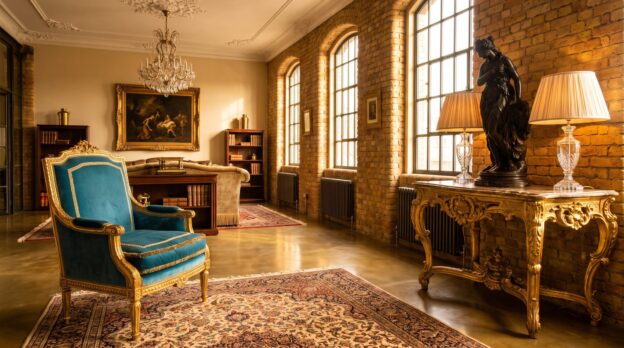
A loft thrives on space, open floor plans, and light that travels across concrete, steel, and pale floors. Yet within this clarity, a void sometimes emerges that calls for counterbalance. Baroque furniture creates this counterbalance without overloading the architecture. It establishes points where the eye lingers, transforming transitional areas into spaces with character.
Choosing a single piece means opting for deliberate tension. A gilded mirror above a steel console, a carved armchair beside a glass wall: these contrasts work because they do not blend but stand alongside each other. The baroque remains foreign within the modern, and that is precisely what creates the effect.
Gilding and Raw Concrete: Why the Contrast Works
Baroque furniture brings ornament, lustre, and craftsmanship into a space designed for reduction. Gilded wood reflects light differently than polished steel or white walls. It scatters warmer, softer, and creates a depth that industrial materials alone cannot achieve. A console table with carved volutes against a concrete wall does not appear misplaced, but rather like a found object that breaks the severity of the space. What matters is that the piece has sufficient space around it. In a loft with three-metre ceiling heights, a baroque piece tolerates air; it must not be wedged between other objects.
From the Casa Padrino collection
Individual Pieces Instead of Ensembles: The Rule of Restraint
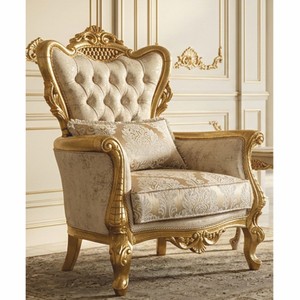
A complete baroque ensemble with table, chairs, and display cabinet would overwhelm a loft. Instead, the strategy of the individual piece works: an armchair, a console, a mirror. These furnishings stand alone; they do not form a group. An Armchairs with carved backrest and velvet upholstery can occupy a loft corner, flanked by a floor lamp and a low marble side table. It becomes a point of rest, not a focal point. The modern remains dominant, the baroque provides accents.
Restraint also applies to colour choice. Gold, silver, or dark wood suit better than multicoloured inlays or lavish upholstery in red and green. Those opting for velvet choose anthracite, midnight blue, or taupe, colours that integrate into the loft’s palette without conforming.
Consoles as Room Dividers: Function and Presence
In open floor plans, walls where furniture can find support are often absent. Consoles offer a solution that is both functional and decorative. A baroque console with curved legs and marble top can be positioned freestanding in the space, perhaps between living and dining areas. It separates the zones without sealing them off, and provides a surface for objects: a vase, a stack of books, a small sculpture. The console becomes a threshold that guides the gaze and structures the space.
Proportion is important. A console should be narrow enough not to block passage, but tall enough to show presence. 80 to 90 centimetres in height is a good guideline. Width depends on room depth: in a loft ten metres wide, the console may measure 120 to 150 centimetres; in smaller spaces, 80 centimetres suffices.
Mirrors and Light: Reflection as Spatial Strategy
Baroque mirrors with gilded frames amplify the light falling through large windows. They optically double the space and bring movement to static walls. A mirror above a console or beside a window front reflects not only light but also the architecture: steel beams, concrete pillars, the edges of furniture. These reflections create layers that make the space more complex without filling it.
The frame should be substantial, with distinct carving and visible gilding. A narrow, restrained frame would be lost in a loft. Casa Padrino offers mirrors large enough to function as independent elements, often 180 to 200 centimetres tall. They lean against the wall or hang centrally above a piece of furniture, never too high, so the reflection remains at eye level.
Sculptures as Bridge Between Inside and Outside
Those with a loft featuring a terrace or roof garden can carry the baroque formal language outdoors. Sculptures in stone or bronze create accents on the terrace that correspond with the furniture indoors. A figure beside the glass door, a pedestal with bust on the parapet: these objects connect the levels and allow the space to grow beyond its boundaries.
Indoors, smaller sculptures work on consoles or side tables. They should be of heavy material, marble or bronze, so they retain weight beside industrial surfaces. Figurative motifs, putti or classical busts, bring a narrative into the space that the modern lacks. They need not be explained; their presence suffices.
Combination Rules: What Stands Beside Baroque
Baroque furniture pairs better with certain modern materials than with others. Glass, marble, and steel are ideal partners because they continue the coolness of the architecture without competing with the ornament. A glass table beside a baroque armchair, a steel lamp above a gilded console: these pairings work because the materials do not touch but exist alongside each other.
- Wood should be dark or black-stained; pale woods appear too soft beside gilding.
- Textiles in velvet or linen reinforce the haptic quality of baroque furniture; cotton or synthetics diminish it.
- Lighting may be modern but should have clear forms: spheres, cylinders, no playful shades.
- Rugs in natural tones or geometric patterns integrate the baroque piece without imitating it.
In terms of colour: fewer colours, more contrast. Black, white, grey, and gold form a safe foundation. Those wanting colour opt for deep tones like midnight blue, bottle green, or bordeaux, always at a single point, never across surfaces.
Spatial Effect and Proportions: What the Individual Piece Achieves
A baroque piece of furniture alters the perception of a loft because it introduces a different temporal layer. The space does not become historical, but it gains depth, a second layer that lies above the present. This layer emerges not through mass but through presence. A single armchair, a console, a mirror: they suffice to shift the atmosphere. Casa Padrino understands this principle and offers pieces crafted to stand alone. The carving is precise, the gilding genuine, the proportions correct.
What Sustains the Space: Clarity and Courage
A loft accommodates baroque when the selection remains clear and the courage to leave gaps exists. Not every corner needs furniture, not every wall a picture. The individual piece works because it has space around it, because it is not part of an accumulation. The tension between old and new, between ornament and reduction, emerges only when both poles are strong enough. Placing a baroque piece of furniture in a loft means choosing friction over harmony. This friction makes the space alive.
Related categories: Resin and Fiberglass Sculptures, baroque mirrors, Side Tables. The full range: Baroque Furniture.