
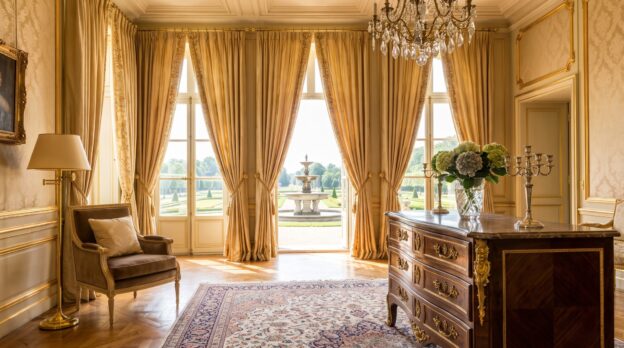
Anyone walking through the parterre of Versailles immediately understands: here, nature was not tamed but composed. Every axis guides the eye, every fountain marks a point in the system, every sculpture stands where geometry and proportion demand it. What began as a demonstration of power in the 17th century can now be read as a design principle: a garden in the French style orders space not through plants alone, but through architecture of stone, water and sight lines.
This approach unfolds its effect even on smaller grounds. A rectangular garden, a terrace overlooking a lawn, a courtyard with high walls: wherever clear lines are possible, the principle of French garden art can be applied. What matters is not the area, but the understanding of how elements relate to each other and how the eye is guided.
The Main Axis as Supporting Framework
Every garden in the Versailles style begins with a central sight line. It runs from the house into the depth of the property, often sloping gently downward, and is emphasised by symmetrically arranged beds, paths or lawns. At the end of this axis stands a focal point: a fountain, a sculpture, a pavilion. These endpoints are not decoration, but architectural statements that give the garden depth and scale. Those who place Fountains and Water Columns at such points create not only a visual destination, but also an acoustic centre that animates the space without dominating it.
The width of the axis is determined by the proportions of the house. A three-bay facade requires a correspondingly wide central axis in the garden, while a narrow town garden manages with a single, precisely placed line. What matters is that the axis remains clearly legible: no shrub may interrupt it, no piece of furniture obstruct it.
From the Casa Padrino collection
Fountains as the Centre of Composition
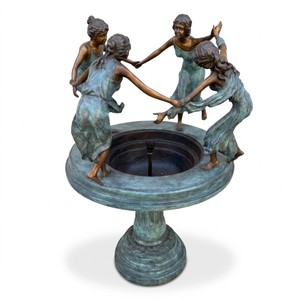
In Versailles, fountains mark the intersections of axes, the crossings of paths, the centres of roundabouts. They are never accessories, but always fixed points. In the private garden they assume the same function: a fountain on the main axis structures the area, creates distance between terrace and garden end, sets a rhythm. Those planning a second fountain position it on a cross axis, so that an intersection point emerges that divides the garden into four quadrants.
Material and form follow the architecture of the house. Natural stone facades suit fountains of sandstone or travertine, rendered villas those of light marble or cast stone. The proportion must be right: a fountain that is too small disappears in the area, one that is too large overwhelms the surroundings. As a rule of thumb, the fountain basin should occupy about one third of the width of the axis on which it stands.
Sculptures as Vertical Accents
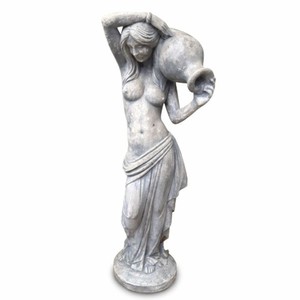
While fountains structure the ground, Sculptures work in the vertical. They stand at the ends of sight lines, flank entrances, mark path crossings. In Versailles they are mythological figures, gods and allegories that populate the garden. In the contemporary context they can also be more abstract forms, as long as they have mass and presence. A sculpture must work from a distance, its silhouette must remain legible against sky or hedge.
The placement follows clear rules: figures look into the garden or along the axis, never to the side or outward. Their height is oriented to the eye level of the viewer: sculptures that are too low disappear between beds, those that are too high appear monumental where elegance is required. Casa Padrino carries figures in various scales, from life-size statues to smaller putti suitable for side paths.
Pedestals and Columns as Ordering System
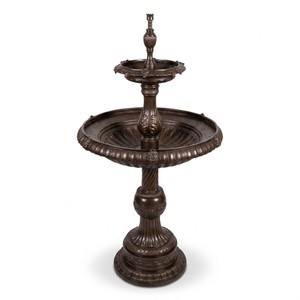
Not every sculpture stands directly on the ground. In the French garden tradition, figures are placed on pedestals to lift them from the vegetation and enhance their effect. These Columns and Pedestals are independent design elements: they create differences in height, give rhythm to a series of objects, connect architecture and landscape. Those planning a balustrade place vases or spheres on pedestals of equal height, so that a continuous line emerges.
Even without sculpture, columns have their justification. They can mark a gateway entrance, begin a sight line or serve as supports for lanterns. Material and profile must match the architecture: fluted columns for neoclassical facades, smooth ones for modern buildings. The height should be oriented to the storey height of the house, so that the proportions remain harmonious.
Symmetry and Repetition
The Versailles garden lives from the repetition of identical elements. Four fountains in the corners of a roundabout, six vases along a balustrade, two sphinxes before a gate: these rhythms create order and calm. In the private garden the principle can be transferred by working in pairs. Two identical sculptures flank the entrance to the terrace, two columns mark the beginning of the main axis, two fountains stand mirror-image to a cross axis.
It is important that the elements are actually identical. Similar but not identical objects disturb the symmetry more than they benefit it. Those ordering from Casa Padrino can ensure that pairs come from the same mould and match in material and patina. The placement must also be exact: even a few centimetres of deviation destroy the effect of the mirroring.
Material, Patina and Care
French garden sculptures are made for eternity. Marble, sandstone, bronze: these materials age with dignity, develop patina without losing their form. Unlike wood or plastic, they gain character over the years. Moss settles in depressions, lichen covers smooth surfaces, water leaves traces. This ageing is intended, it connects the objects with the place.
Nevertheless, stone and metal require care. Fountains must be emptied in winter, bronze should be waxed occasionally, sandstone does not tolerate aggressive cleaners. Casa Padrino provides care instructions for each object, tailored to the material. Those who follow these ensure not only durability, but also the aesthetic development of the pieces.
Light and Shadow as Design Tools
A garden in the Versailles style unfolds its full effect only in the interplay of light and shadow. Sculptures cast hard shadows on gravel paths, fountains glitter in the midday sun, columns stand out against the evening sky. These effects can be controlled through placement: figures on the south side of the garden are illuminated all day, those in the shade of high hedges develop a darker, more mysterious presence.
Artificial lighting enhances the effect after nightfall. Ground-recessed spotlights stage sculptures, underwater lights make fountains glow, lanterns on columns mark paths. The light colour should be warm to support the natural tones of stone and bronze. Cold LED light distorts the materials and destroys the atmosphere.
What Sustains the Garden
A garden in the French style is not a collection of beautiful objects, but a considered system of axes, symmetries and focal points. Fountains, sculptures and columns are the supporting elements of this order. They create depth, structure the area, guide the eye. Those who place them with precision and coordinate them in material and proportion create a space that not only represents, but also invites contemplation. The art lies in combining rigour with elegance and giving nature a framework in which it becomes architecture.
Related categories: Sofas, Mirrors, Garden Fountains. The full range: Baroque Furniture.