
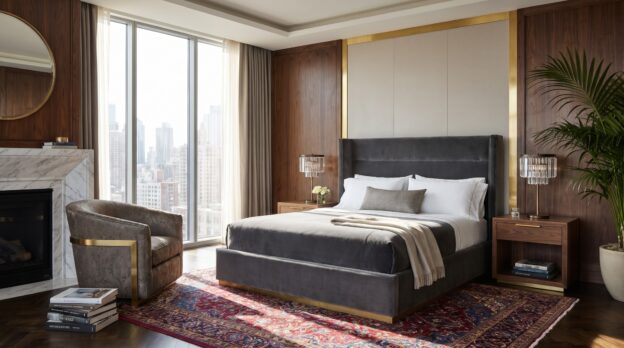
When you enter a hotel room and immediately sense that someone has understood what tranquility means, it is rarely due to a single piece of furniture. It is the way light falls on a tabletop, how an armchair relates to the bed, how much space remains between objects. Luxury hotels work with a choreography of proportions, materials and restraint. They create spaces where you arrive without knowing why.
These principles can be translated into your own home. Not as a copy, but as an attitude: less decoration, more structure. Less coincidence, more decision. What works in a hotel room of twenty square metres unfolds a similar effect in a bedroom or suite at home. It is about clarity, not coldness.
The bed as a calm centrepiece
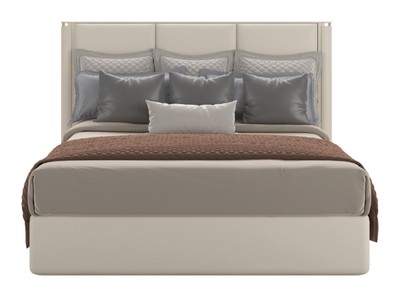
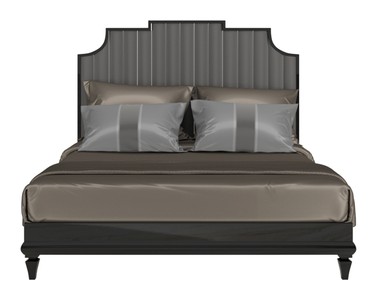
In every good hotel room, the bed is the undisputed centre. It stands free, often centred to the wall, surrounded by air. The bed linen is white or in muted natural tones, the pillows are numerous but ordered. No patterns competing for attention. Instead, fabrics that differ through texture: linen, cotton sateen, perhaps a throw in cashmere or wool. Casa Padrino shows how high-quality Beds with clean lines and fine covers carry a room without dominating it.
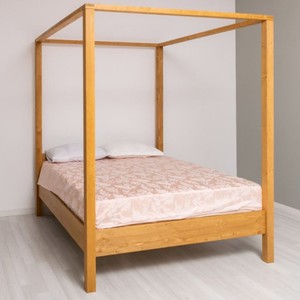
Height is crucial. Luxury hotels favour beds that appear slightly elevated, often through an upholstered headboard reaching halfway up the wall. This gives the room structure and the bed weight without becoming bulky. Avoid low futon beds if you are aiming for hotel flair. The proportions only work when the bed has a certain presence.
From the Casa Padrino collection
Symmetry creates security
Enter a hotel room and you will usually find identical bedside tables, identical lamps to the left and right of the bed. This symmetry is no coincidence. It calms the eye, creates order without having to think about it. In your own bedroom, the principle can be adopted: two identical lights, two identical surfaces. No different heights, no improvised solutions.
The bedside tables themselves should be simple. Dark wood, marble, metal in matt finish. No open shelves, no visible cables. Casa Padrino offers Side Tables in solid oak or with brass details that fulfil precisely this function: they are there, but they do not impose themselves. A small drawer is enough to store the essentials. Everything else belongs elsewhere.
Thinking of light in layers
Hotels never work with a single light source. Instead, there are several levels: ceiling lights for basic brightness, reading lights by the bed, a floor lamp in the corner, perhaps indirect lighting behind the headboard. Each light source has a function, and all together can be dimmed.
For home, this means: forgo the one large ceiling lamp. Instead, rely on table lamps with warm white light, on wall lights with swivel arms, on dimmers at every point. The colour temperature should be uniform, around 2700 Kelvin. Cool white light destroys any hotel atmosphere immediately. Here too: less is more. Three well-placed light sources are better than five mediocre ones.
Materials you can feel
Luxury hotels rely on materials that convince haptically. Solid wood, genuine leather, stone, linen. No plastic surfaces, no foils imitating wood. The surfaces may be matt, even slightly rough. High gloss quickly appears cheap, unless it is polished marble or lacquered metal in small doses.
Combine a maximum of three materials per room. For example: dark oak, light marble, matt brass. Or: oiled walnut, cognac leather, black metal. The repetition of these materials in different places creates coherence. A brass handle on the wardrobe, a brass base on the lamp, a brass frame on the mirror. The eye recognises the pattern and perceives it as harmonious.
The armchair that must not be missing
In almost every upscale hotel room there is an armchair. Not as a place to store clothes, but as a place. A place to drink coffee in the morning, read a book in the evening, simply sit in between. This armchair is never too small and never too bulky. It has armrests, a slight incline, often a footstool nearby.
Casa Padrino offers Armchairs in classic forms that maintain precisely this balance: comfortable but not too deep, elegant but not fragile. The cover should be robust, velvet or firm linen, in a colour that fits into the overall palette. Do not place the armchair directly by the window, but slightly offset, with a small side table next to it. This creates a separate zone in the room without fragmenting it.
Few things, but the right ones
Hotels do not display personal items. No photographs, no souvenirs, no collections. Instead: a tray on the desk, a carafe with glasses, perhaps a single sculpture. This reduction is not renunciation, but concentration. Each object has weight because it does not have to compete with others.
- Choose a colour palette of three tones and stick to it: for example white, grey, dark wood.
- Avoid patterns on large surfaces. If patterns, then on cushions or a rug, never on curtains and bed linen simultaneously.
- Leave surfaces empty. A bedside table with lamp and book is enough. No alarm clock, no charging cable, no cream.
- Invest in curtains that reach the floor and fall heavily. Linen or cotton velvet, in a colour that differs only slightly from the wall.
Order as a system, not as an effort
In a hotel room, everything has its place because the place was considered from the beginning. No open shelves, no visible cables, no provisional solutions. Transferred to your own home, this means: create closed storage spaces. Built-in wardrobes reaching to the ceiling, chests of drawers with smooth fronts, boxes in uniform colours.
This approach demands discipline, but it pays off. When every object has a fixed place, the room remains calm even when used daily. Hotels prove that order does not mean sterility. It is the prerequisite for materials and proportions to take effect.
What carries the room
Hotel flair does not arise through decoration, but through omission. Through the decision to show only what truly counts: a bed that invites, an armchair that stays, light that can be adjusted, materials you like to touch. Casa Padrino understands these principles and translates them into furniture that does not look like a hotel, but conveys the feeling. It is about spaces where you arrive without having to explain why.
Related categories: Garden Fountains, Chairs, Display Cabinets. The full range: Baroque Furniture.