
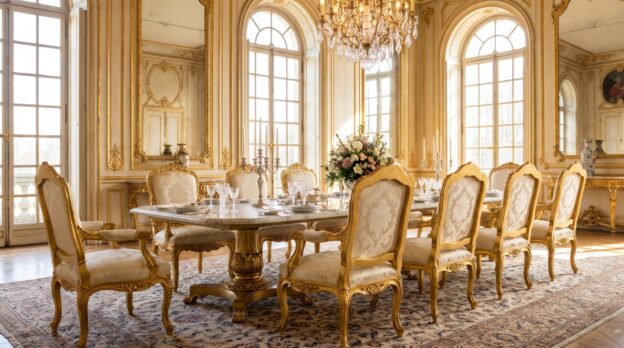
A dining table made of dark wood stands in the room, its surface catching the light from the windows, its edges cleanly drawn. Yet only when the chairs find their place does it become clear whether the room breathes or stiffens. A baroque chair with a curved backrest, gilded carvings and a velvet seat transforms the table into a stage. It brings weight, posture and a gesture that goes beyond mere sitting. The chair is not an accessory, it is the silent partner that lends the table its dignity.
Anyone who owns a representative dining table knows about the tension between surface and surrounding space. The table needs framing, and this is created not through quantity but through form. Baroque chairs set accents that guide the eye: upward, to the backrest, to the legs, back to the centre. They create rhythm and make the room appear larger because they structure it. The question remains which chairs suit which table and how much ornamentation a room can bear without losing its clarity.
The Backrest as an Architectural Element
The backrest of a baroque chair is more than a support. It stands vertically in the room, often over a metre high, forming a vertical line that frames the dining table. Carved volutes, acanthus leaves or rocailles set accents without overloading the silhouette. Proportion is decisive: a tall, narrow backrest stretches the room, a broader form with an expansive crown gives the table weight. Casa Padrino crafts chairs with backrests where the carving is positioned to work from a distance without being intrusive in detail. The eye follows the line, not the ornament.
From the Casa Padrino collection
Material and Surface in Dialogue with the Table
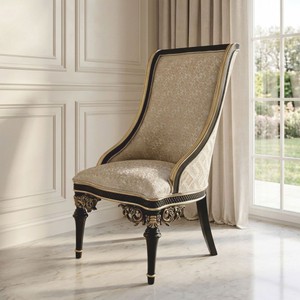
A dining table made of solid walnut or oak demands chairs that absorb its materiality without duplicating it. Beech or ash, stained in a dark tone, create continuity. Gilded accents on legs or rails break the heaviness and bring light into the composition. Velvet seats in burgundy, emerald or anthracite set colour points that do not compete with the table but complement it. Those who choose Dining Tables made of light wood or with a marble top can work with darker chairs to create contrast. The surface of the wood should be matt or satin matt, high gloss often appears too smooth next to baroque carving.
Number and Arrangement: Symmetry Without Rigidity
A rectangular table carries six to eight Chairs, depending on length. The spacing is decisive: 60 centimetres width per seat, so that the backrests do not stand too close together. At the head ends, armchairs can stand, giving the table framing without shortening it. Chairs without armrests placed at the sides keep the line open. Those who own a round table choose chairs with narrower backrests so that the circle does not break. Casa Padrino offers models whose legs are set slightly outward, which enlarges the base and simultaneously creates lightness. Symmetry arises through repetition, not through force.
Combination Rules for Baroque Chairs and Modern Tables
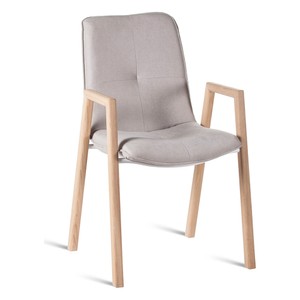
Baroque chairs also work alongside contemporary tables when the proportions are right. A simple table with a steel frame or clear wooden top gains depth through ornamented chairs without appearing historical. Several principles apply that control the break:
- The seat height must match the table top: 45 centimetres seat height at 75 centimetres table height is standard.
- Colour contrasts sharpen the effect: dark chairs with a light table, gilded details with matt metal.
- Maximum two materials in the chair: wood and fabric or wood and gilding, not all three at once.
- The leg form of the chair should differ from the table leg form: curved cabriole legs next to straight table legs, not the reverse.
The Space Around the Table: Distance and Sight Lines
A dining table with baroque chairs needs air. At least 80 centimetres distance to the wall or to other furniture, so that the chairs can be pulled out without bumping. Those who place Display Cabinets or sideboards in the room should ensure that their height does not exceed the chair backrests. Otherwise a break occurs in the vertical structure. Mirrors on the wall behind the table double the effect of the chairs and make the room appear deeper. Lights above the table must not hang too low, 70 centimetres above the surface is a good guideline so that the backrests remain visible.
Upholstery and Cover: Haptics as Silent Luxury
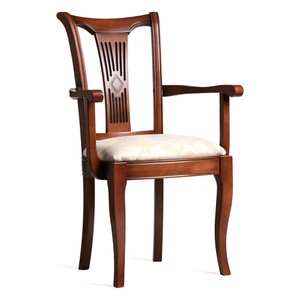
The seat surface of a baroque chair is often upholstered, with foam or horsehair, covered with fabric. Velvet is the classic choice because it absorbs light and gives depth. Linen or heavy cotton velour work equally well if the weave is dense. Patterns should be restrained: tone on tone, stripes or small ornaments, no large-scale prints. Casa Padrino upholsters chairs with fabrics tested for abrasion resistance, at least 30,000 Martindale, so that the surface does not fray even after years. The seam between seat and rail should be cleanly worked, without visible staples. Those who have children or pets choose darker tones or have the covers removed and cleaned.
Patina and Care: How Wood Ages
A baroque chair made of solid wood changes over the years. Beech darkens, oak becomes greyer, walnut gains depth. This patina is intended, it makes the chair a witness to its use. Gilding can become matt, which gives it a calmer radiance. Care means: remove dust with a soft cloth, no polish on carved surfaces because it settles in the recesses. Vacuum seat covers regularly, dab stains immediately with clear water, do not rub. Casa Padrino recommends treating wood surfaces once a year with colourless hard wax, applied thinly and polished after an hour. This keeps the surface breathable and prevents it from absorbing moisture.
What Carries the Room: Clarity Through Repetition
A dining table is ennobled by chairs when they speak a common language. Not every detail must be identical, but the basic form should repeat: the height of the backrest, the curve of the legs, the colour of the wood. Baroque chairs bring verticality into the room, they structure the surface and create rhythm. The table becomes the centre, the chairs the framing. Those who find this balance create a room that shows posture without imposing itself.
Related categories: Garden Decoration, Garden Furniture, Baroque and Art Nouveau Garden Furniture. The full range: Baroque Furniture.