
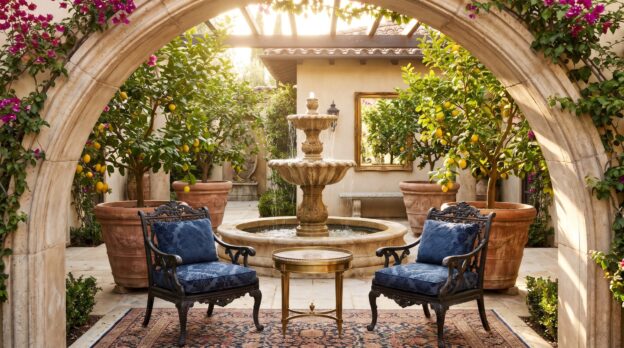
A courtyard of pale sandstone, a terrace between box hedges, or a square beneath old plane trees: where water falls, space becomes concentrated. A fountain sets a point around which paths, seating areas, and plantings arrange themselves. It gives the garden structure and transforms silence into sound. When placed correctly, it creates a place that cools in summer and retains presence in winter.
The effect does not arise from size alone. What matters are proportion, material, and the relationship to the surrounding space. A fountain made of natural stone integrates differently than a model in bronze or cast iron. The water movement determines whether the garden comes to rest or gains vitality. Those who understand these parameters can deploy the fountain so that it becomes a natural focal point.
Material and Form: How the Fountain Shapes Space
Natural stone in grey or beige integrates into classical garden architecture. Granite, sandstone, or travertine age with patina and appear as if they have always been there. Bronze develops a greenish oxide layer that emphasizes Mediterranean courtyards and formal gardens. Cast iron in black or dark green suits historic estates and townhouses with brick facades. Garden Fountains made from these materials carry the garden through decades without losing presence.
Form follows function: round basins with central water jets create symmetry and direct the gaze inward. Multi-tiered models with cascades structure space vertically and create depth. Wall fountains save space and suit narrow courtyards or terrace walls. The height of the fountain should match the surroundings: in a small courtyard, 80 to 120 centimeters suffice; on large terraces, 150 to 200 centimeters are appropriate.
Placement: Where Water Becomes the Centre
The fountain stands where sight lines intersect. In a square courtyard, it marks the centre, surrounded by gravel or paving. On a terrace, it moves to the edge or into a corner, so that seating surrounds it without blocking passage. In front of a hedge or wall, it gains depth because the dark green lifts the pale stone surface.
The distance to seating groups should be two to three meters. This keeps the sound of water present without drowning out conversation. Plants in pots or low beds frame the fountain without obscuring it. Boxwood, lavender, or grasses in grey and green create transitions between stone and vegetation. Casa Padrino offers Fountains and Water Columns in various scales that can be precisely matched to room size.
Water Movement: Sound and Rhythm in the Garden
A thin jet rising vertically from the centre and falling quietly into the basin creates calm monotony. Cascades running over several tiers bring movement and fill the space with layered rushing. Wall fountains with broad water curtains create an even backdrop that dampens background noise.
Volume can be regulated via pump output. In a quiet courtyard, a gentle flow audible only from close range suffices. On a terrace by a busy street, the water may fall more loudly to overlay external noise. The water surface reflects light and amplifies the effect of sunlight or outdoor lighting. In winter, when the pump is switched off, the sculpture remains as a resting point.
Combinations: Furniture and Decoration in Harmony
Teak furniture in warm brown harmonizes with stone fountains in beige or grey. Wrought iron chairs and tables suit cast iron and bronze. White garden furniture in aluminum or lacquered metal creates contrasts with dark fountains and establishes a light, modern atmosphere. Cushions remain restrained: linen in natural, grey, or blue-grey integrates into the color palette.
Additional elements from the Garden Decoration range reinforce the effect without competing. Lanterns in iron or brass flank the fountain and set accents in the evening. Planters in the same material language create repetition and order. Sculptures or obelisks stand at sufficient distance so that the fountain retains its central role. Casa Padrino carries collections that are coordinated with one another and enable coherent design.
Technical Details: Function Without Effort
The pump operates in a closed circuit and requires only an electrical connection. Water circulates through filters that retain leaves and debris. An overflow protection prevents the basin from overflowing in rain. In autumn, the pump is removed, the water drained, and the basin covered with a tarpaulin. Frost-resistant materials such as granite or cast iron survive winter without damage.
Installation requires a stable foundation of concrete or compacted gravel so that the fountain does not subside. An electrician lays the cable underground and secures it with a residual current circuit breaker. Commissioning takes a few hours; afterwards, the system runs with low maintenance throughout the entire season.
Light and Season: Staging Throughout the Year
During the day, natural light suffices to make the water surface gleam. In the evening, ground spots or underwater spotlights stage the fountain. Warm white light emphasizes the structure of the stone without distorting the atmosphere. LED technology saves energy and allows control via timers.
In spring, fresh perennials surround the fountain; in summer, the water noticeably cools the air. In autumn, dark foliage contrasts with pale stone; in winter, the sculpture becomes a resting focal point among bare branches. Those who leave the fountain visible year-round create continuity and prevent the garden from losing its centre in winter.
Proportions and Scale: Size in Relation to Space
A fountain with an 80-centimeter diameter suits a terrace of 15 square meters. At 30 square meters, 120 to 150 centimeters are appropriate. In large courtyards or park gardens, models with two meters diameter carry the space without disappearing. Height should not exceed one and a half times the diameter, otherwise the fountain appears unstable.
- Small courtyards: wall fountains or single-tier models up to 100 centimeters high
- Medium terraces: round fountains with 120 to 150 centimeters diameter, two to three tiers
- Large gardens: multi-tiered cascades from 180 centimeters high, freestanding in the centre
- Narrow passages: wall fountains with flat relief, 60 to 80 centimeters wide
Why the Fountain Carries the Garden
A fountain orders outdoor space without dominating it. It creates a point that attracts gazes and brings movement into stillness. Material, form, and placement determine whether it integrates or remains foreign. Those who pay attention to proportions and relate the fountain to furniture and plants gain a focal point that carries through years. Water cools in summer, stone remains in winter. Thus the terrace or courtyard becomes a place that has its centre in every season.
Related categories: Decorations, Dining Tables, Garden Furniture, Stoves and Decoration. The full range: Baroque Furniture.