
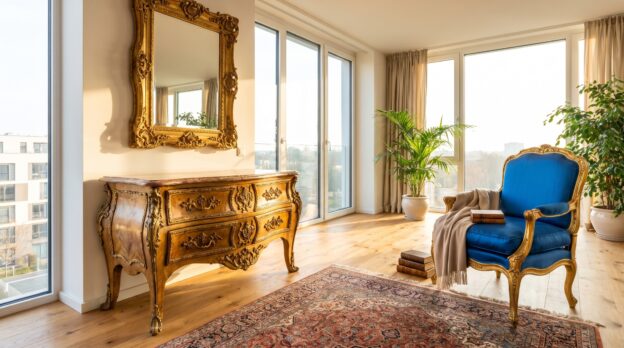
The walls are white, the windows frameless, the floor made of light oak concrete. A new building that promises light and spaciousness, clean lines and architecture that does not impose itself. And then there stands a chest of drawers with curved legs, gilded carvings and a marble top that reflects the daylight in warm glimmers. What appears at first glance to be a misunderstanding is, upon closer inspection, a dialogue that creates tension and gives the room depth.
Baroque furniture in new buildings works not despite the contrast, but because of it. It breaks the cool restraint of modern architecture and sets accents that emotionally charge the space. The prerequisite is that the stylistic break is consciously staged: with a sense of proportion, clear rules and an instinct for when a piece of furniture becomes a statement and when it overloads the room.
Why Baroque and New Buildings Complement Each Other
Modern architecture thrives on reduction. Smooth surfaces, right angles, a colour palette limited to white, grey and concrete. This creates calm, but can also appear sterile. Baroque furniture brings precisely what this aesthetic lacks: ornamentation, craftsmanship, history. A baroque console with its curved volutes or a mirror with a gilded frame sets a counterpoint that does not disturb the room, but completes it. The clear architecture becomes the frame, the baroque piece the picture.
From the Casa Padrino collection
The Right Measure: Less Is the Key
A stylistic break only works if it remains measured. Anyone furnishing a new building with baroque furniture should limit themselves to a few, distinctive pieces. A single Armchairs with embroidered velvet and turned legs can become an eye-catcher in a minimalist living room without tipping the spatial effect. What matters is that the furniture has space around it. In an open floor plan, typical of new buildings, a baroque piece needs air so that its form comes into its own. Too many ornaments in a confined space create restlessness, whereas a single object gains presence.
Materials That Build Bridges
The contrast between old and new becomes bearable when materials mediate. Marble, brass, dark wood or velvet are surfaces that appear in both baroque and contemporary interiors. A baroque console made of walnut with brass inlays harmonises with a modern kitchen if brass also appears on the fittings or handles. Colour can also connect: an armchair in deep blue or emerald green finds connection when the same tone recurs in cushions, curtains or a rug. At Casa Padrino, you will find baroque furniture that is so flexible in its colouring and choice of materials that it fits into a wide variety of spatial concepts.
Where Baroque Furniture Finds Its Place in New Buildings
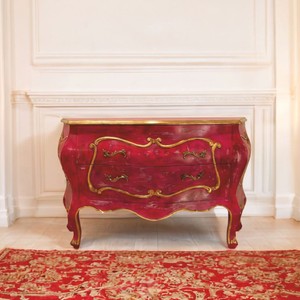
Not every room tolerates the stylistic break equally well. In the entrance area, a magnificent chest of drawers with a marble top and gilded fittings can set the tone without competing with other furniture. It stands alone, welcomes, gives the room weight. In the living room, a baroque coffee table or a large Mirrors above the sofa works, provided the rest of the furnishings remain restrained. In the bedroom, a bed with a high, carved headboard can dominate the room, while bedside tables and wardrobes are kept simple. What matters is that the baroque furniture does not disappear into a corner, but occupies a central position.
Concrete Combinations That Work
Anyone unsure how to combine baroque and modern styles can follow proven patterns. The following combinations create balance:
- A baroque velvet armchair next to a simple side table made of metal and glass.
- An opulent chest of drawers beneath a large-format, abstract painting in black and white.
- A gilded wall mirror above a minimalist oak sideboard.
- A baroque bed with white bedding and a modern reading lamp made of matt steel.
- A baroque console in the hallway, with a contemporary sculpture or simple vase on top.
Consider Light and Proportions
Baroque furniture is often dark, solid, with much ornamentation. In a new building with large windows and high ceilings, this is not a problem, quite the contrary: daylight makes gilding shine and brings carvings to life. In smaller rooms or with low ceilings, one should be more cautious. Here, furniture with lighter woods or those that are more compact in proportion are recommended. Ceiling height also plays a role: a baroque piece of furniture with much vertical articulation, such as a tall cupboard or a mirror with an expansive frame, needs ceiling height to avoid appearing squat.
Colour as Mediator or Amplifier
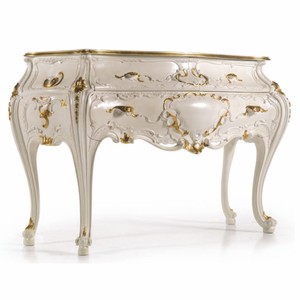
Anyone wanting to sharpen the contrast leaves the walls white and opts for dark, richly decorated furniture. Anyone wanting to soften it works with wall colours in muted tones: taupe, greige, a warm grey. These colours take away the theatricality of the baroque furniture without diminishing its effect. Commodes in white or cream with golden accents also integrate more gently than dark walnut or mahogany variants. What matters is that the room’s colouring does not contradict the furniture, but frames it.
What Carries the Room
Baroque furniture in new buildings is not a contradiction, but an enrichment when chosen and placed with care. The stylistic break succeeds when a few strong pieces stand in a clear, restrained environment, when materials and colours build bridges and when the room allows enough air for the ornamentation to breathe. Casa Padrino offers a selection of baroque furniture that is of such high quality and craftsmanship that it holds its own even in modern surroundings. What remains is an interior that does not shy away from contrasts, but uses them to create rooms with character and depth.
Related categories: Baroque and Art Nouveau Garden Furniture, Consoles, Columns and Pedestals. The full range: Baroque Furniture.