
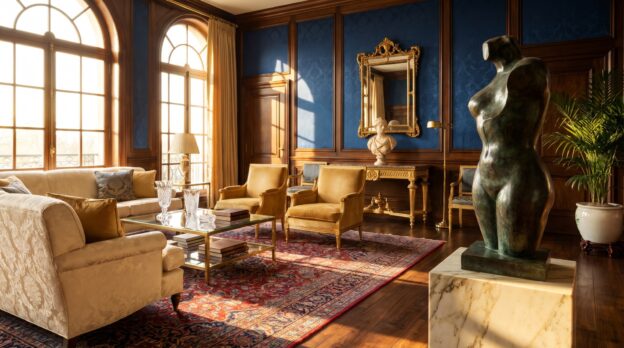
When you place a sculpture in the living room, you bring in more than an object. A dialogue emerges between volume and void, between the stillness of a figure and the movement of the space. A bronze bust on the console, a marble torso beside the fireplace, an abstract relief on the wall: such pieces need space around them so their form can take effect. They alter the atmosphere because they have weight, presence, a language of their own.
Proportion is decisive. A figure that is too small disappears beside a large sofa, one that is too large overwhelms the room. Material and location must harmonize. Bronze tolerates warm light and dark wood, marble requires distance from patterned fabrics. Those who understand these principles create rooms that do not appear decorated, but composed.
Material and Spatial Effect: Bronze, Marble, Stone
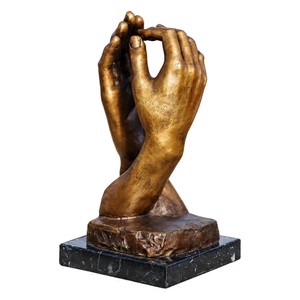
Bronze brings warmth to cool rooms. The patina shimmers greenish, brownish or almost black depending on the incidence of light. Beside leather, dark oak or velvet, the material unfolds its full depth. Marble, by contrast, appears cool and clear. White Carrara beside pale walls creates calm, black Marquina sets a graphic accent. Sandstone and limestone lie between: more matte, more earthy, less dramatic. Casa Padrino carries Sculptures in all three materials, from classical busts to abstract forms that integrate into modern interiors.
From the Casa Padrino collection
Proportion and Location: Where the Figure Stands
A sculpture requires a place where it can breathe. On a narrow chest of drawers the volume is lost, on the floor beside a low sideboard the height is missing. Elevated surfaces are ideal: a wide windowsill, a side table, a niche in the wall. Eye level plays a role. A bust at chest height demands eye contact, a figure on a low pedestal invites circumnavigation. Those who combine several pieces work with distance and difference in height. Two figures of equal size side by side appear static, a tall one beside a low one creates tension.
Pedestal and Base: The Invisible Architecture
A pedestal is more than a shelf. It lifts the sculpture out of the everyday, gives it significance, creates spatial hierarchy. Marble on marble functions when the veining contrasts. Bronze on dark wood or matte stone allows the figure to shine. The height of the pedestal determines how close the sculpture comes to the viewer. A low pedestal integrates the object into the room, a high one isolates it, makes it the focus. Casa Padrino offers Columns and Pedestals in various heights and materials that can be adapted to the proportions of the room.

Light and Shadow: How Form Emerges
A sculpture lives by light. Diffuse daylight reveals the form gently, directed light from the side emphasizes contours and casts shadows. A spotlight from above dramatizes, a table lamp from below distorts. Bronze responds to warm light with golden reflections, marble to cool light with crystalline clarity. Those who place a figure beside a window must reckon with changing light conditions. The sculpture appears different in the morning than in the evening. This is not a disadvantage, but part of the staging.
Combination with Furniture: Console, Sideboard, Mantelpiece
The sculpture needs a counterpart. On a baroque console a historical dialogue emerges, on a plain sideboard a modern contrast. The width of the surface should be at least one and a half times the sculpture base, so the object does not appear precarious. A bust on too narrow a Consoles tilts visually, even if it stands securely. Depth is equally important: the figure must not project over the edge, but needs space to the rear so as not to appear pressed against the wall. A distance of ten to fifteen centimeters from the wall allows shadows to form and gives the form air.
Rules for Placement: Concrete Dimensions and Distances
- Sculpture height maximum one third of room height, otherwise the object dominates too strongly
- Distance to the nearest wall or nearest piece of furniture at least half the sculpture width
- Pedestal height between 60 and 120 centimeters for busts, 30 to 60 centimeters for torsos and figures
- With multiple sculptures: distance between them at least twice the greatest width
- No sculpture directly beside patterned wallpaper or heavily textured surfaces
Color and Surroundings: What the Sculpture Bears
A dark bronze demands pale walls or a neutral background. Marble tolerates color, as long as it does not compete with the veining. A white torso before an anthracite wall gains contour, a black one before white gains drama. Patterned fabrics, ornamental wallpaper or restless shelving distract. The sculpture needs silence around it. This does not mean the room must be empty. A single picture, a stack of books, a vase: such elements can accompany the figure, as long as they do not compete with it for attention.
What the Room Bears: Presence Without Pathos
A sculpture in the living space is not a statement, but an offer. It invites one to pause, to contemplate a form, to perceive a surface. Casa Padrino understands this attitude and offers pieces that do not impose themselves, but also do not disappear. Those who work with material, light and proportion create rooms in which sculptures are not exhibited, but integrated. The result is not a museum, but a home that does not merely display art, but lives it.
Related categories: Beds, Flower Pots, Fountains and Water Columns. The full range: Baroque Furniture.