
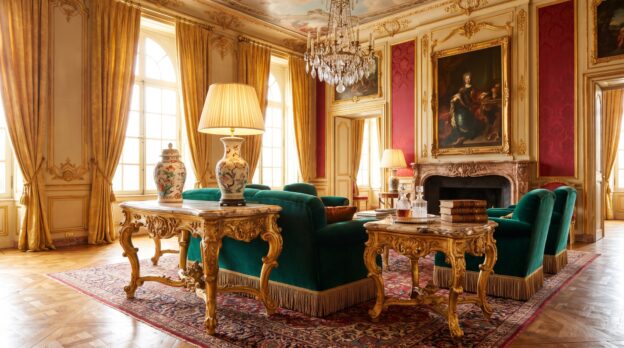
A salon lives from grand gestures: the sofa, the chandelier, the wall mirror. Yet those who look closely recognise the quiet mediators that make the room truly habitable. A glass of wine finds its place, a book waits within reach, a lamp casts its light precisely where it is needed. These tasks are performed by furniture that rarely takes centre stage, but without which no salon functions.
Side tables are these unsung heroes. They stand beside the armchair, flank the sofa, accompany the bed. Their size makes them flexible, their form allows them to disappear or emerge, depending on what the room demands. Those who choose and position them correctly create order without it appearing systematic. Those who underestimate them lose comfort and harmony.
The Right Height: Function Follows the Seat
A side table next to an armchair should stand at the same height as the armrest or just below it. This allows a glass to be set down without raising or stretching the arm. With a low lounge chair, the table may be correspondingly lower; with a tall wingback chair, it rises accordingly. The difference should not exceed five centimetres. Those who coordinate Armchairs and tables create a unity that feels natural.
From the Casa Padrino collection
Proportions: Size and Base in Balance
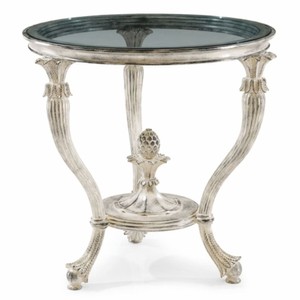
The tabletop should measure approximately one third to half the width of the armchair. A table that is too small appears lost, one that is too large imposes itself. Round tables occupy less visual space than angular ones, even when the base area remains the same. In narrow salons, they are therefore the better choice. Square or rectangular models bring clarity when the room already has many curved lines. Casa Padrino offers both forms in classic and modern designs, so that a solution can be found for every room geometry.
Material and Surface: What the Room Can Bear
Marble brings coolness and weight, wood warmth and texture, metal lightness and lustre. A dark salon with heavy curtains can accommodate a table of polished brass or light travertine that reflects light. A bright room with abundant daylight may accept a table of walnut or black granite without appearing oppressive. The surface determines maintenance: high gloss shows every fingerprint, matte stone forgives more. Those with children or pets choose robust materials without sensitive finishes.
Combination Rules: Unity Without Monotony
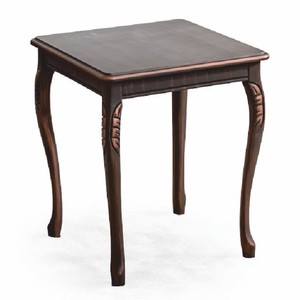
A salon does not require the same side table everywhere. Two to three different models that share a common element create variety without restlessness. The connecting link may be colour, material or formal language. Concrete examples:
- Two round marble tables at different heights, one with a brass frame, one with a black iron frame.
- A rectangular table of dark wood beside a round one of light wood, both with turned legs.
- A tall glass table with a chrome base beside a low one of smoked glass with matte stainless steel.
- An antique mahogany side table combined with a modern one of oiled oak, both in warm brown tones.
The Side Tables from Casa Padrino can be combined so that the salon gains depth without losing its line.
Placement: Proximity and Distance
A side table stands where the hand can reach it without the body having to twist. Next to an armchair, this means a maximum distance of 30 centimetres between armrest and table edge. With a sofa, the table may also stand behind the backrest if a reading corner is created there or a lamp requires space. Two armchairs facing each other share a table in the middle. The distance between the armchairs should then not exceed one metre, otherwise the table becomes a barrier rather than a bridge.
Extending Function: More Than a Surface
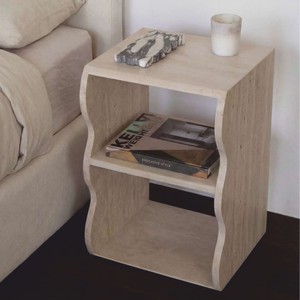
A side table can achieve more than merely supporting objects. Models with a drawer or compartment offer storage for remote controls, spectacles, notebooks. A table with two levels separates functions: the glass above, the magazine below. A rotating table adapts to changing situations. Those who also use the table as a pedestal for Decorations choose a model with sufficient depth so that a vase or sculpture does not wobble. Casa Padrino offers tables that fulfil this dual role elegantly.
Style Directions: From Baroque to Modern
A baroque side table with gilded carvings and curved legs demands a room that can bear opulence. It harmonises with heavy velvet, crystal and dark woods. A table in the Art Nouveau style with floral inlays and slender proportions suits rooms that combine ornament and lightness. A modern table of steel and glass fits into clear, reduced salons in which each piece of furniture speaks for itself. Casa Padrino covers this spectrum and makes it possible to coordinate the table precisely with the existing style or deliberately create a contrast.
What Supports the Room
A side table is not a supporting actor. It organises daily life without imposing itself, and gives the salon a structure that one senses but does not see. The right height makes it usable, the right size keeps it in balance, the right material allows it to merge with the room or stand out. Those who master these parameters create a salon that not only looks beautiful but feels right. The unsung heroes deserve this attention.
Related categories: Garden Furniture, Stoves and Decoration, Garden Decoration, Garden Furniture. The full range: Baroque Furniture.